TEXAS COAST · ROD CHOICE
Choosing a Rod for Wind and Redfish
The shot happens fast and the Gulf wind does not care about your plan. Here is how rod weight, line, leader, and fly size come together on the Texas coast.
By GUADALUPE ROD CO · 10 min read · September 2026 · Redfish and Speckled Trout
A redfish appears at 11 o’clock, the wind hits your casting shoulder, and the easy practice cast suddenly is not easy. Welcome to the Texas coast.
From New Braunfels, Port Aransas and Rockport are close enough for a quick escape, with Port Mansfield waiting farther south when there is more time. Coastal fishing asks more from the rod—and from the angler—because the flies are bigger and the good shot may disappear in seconds.
The first good cast may be the only one
A redfish can suddenly appear along a grass line, push through a shallow pocket, or expose its tail before vanishing. On a skiff, a guide may give you a direction and distance with only a short section of line outside the tip. While wading, you may see one push with no warning.
Distance helps, but speed and accuracy catch more fish. A 90-foot cast is not useful if it takes six false casts to deliver it. Most anglers will catch more redfish by learning to place an accurate 40- to 60-foot cast quickly from an imperfect starting position.
Choose the rod weight for the trip
For most Texas redfish fishing, the 8-weight remains the dependable standard. It generates line speed in wind, turns over weighted shrimp and crab patterns, controls a strong fish around grass, and still remains manageable through a full day.
A fast-action 7-weight makes average redfish more exciting in calm weather, protected water, and with smaller flies. It is a fun second coastal rod, although it asks more from the caster when wind or fly size increases.
A 9-weight becomes useful in consistently strong wind, with heavier flies, or around larger fish. A 10-weight is a specialized tool for the most demanding conditions. Choose the rod for the fishing you expect, not the largest fish you can imagine.
Tight loops and useful speed
A good saltwater rod should recover quickly. When the rod stops, the tip needs to settle cleanly so the cast forms a tight loop and maintains speed. An open loop gives coastal wind more time to disrupt the line.
Fast action does not mean casting wildly. The stroke should remain smooth, but a fast carbon blank responds to a compact movement and decisive stop. That responsiveness matters when you must pick up the line, change direction, and deliver again before the fish disappears.
Match the rod and line to coastal flies
Redfish flies create more air resistance than their size suggests. Weighted eyes, weed guards, crab bodies, shrimp legs, and baitfish materials all affect how a pattern travels. Common choices include shrimp, crabs, spoon flies, Seaducers, Clouser-style minnows, sliders, gurglers, and the locally focused patterns found through Skiff Wanderer.
A floating saltwater line covers most shallow-water redfish situations because it is easy to pick up, redirect, and keep above grass. A powerful front taper helps turn over weighted flies. An intermediate line becomes valuable for speckled trout over deeper grass, channels, drop-offs, and subsurface baitfish work.
Build the leader for the water
In clear, calm water, a 9- to 12-foot leader with a lighter fluorocarbon tippet separates the fly from the line. In stained water or strong wind, a shorter 7½- to 9-foot leader ending around 16- to 20-pound material provides more reliable turnover.
The butt section should transfer energy from the line, while the tippet provides abrasion resistance without killing the fly’s movement. Adjust for fly size, visibility, oysters, and structure.
What we want in a saltwater workhorse
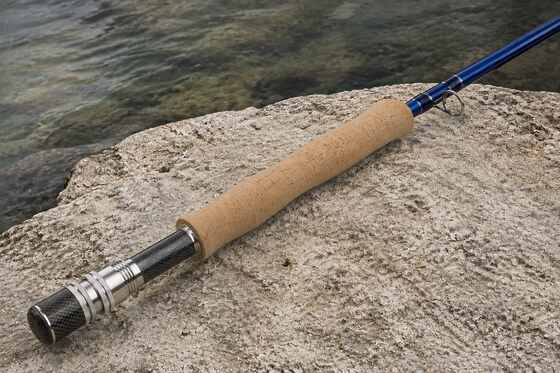
Coastal rods deal with salt, heat, boat decks, wading, travel, and a full day of hard casting. We start with a quick-recovering carbon blank, then use corrosion-resistant stainless hardware, saltwater guides, a durable acrylic insert, a full-wells grip, fighting butt, and a reel seat that stays secure.
Those parts have jobs. Acrylic gives the reel seat character without using a material likely to swell after repeated water exposure. Stainless hardware stands up better to salt. A full-wells grip supports your hand through repeated casts.
No rod is maintenance-free. Rinse it with fresh water after every salt trip, let it dry before returning it to the sock and tube, and check the guides and reel seat for trapped salt or sand.
Our redfish limited runs
Saltwater rods are not an everyday production model for us. Instead, we like to create a focused redfish run each year when we can source the right blanks and components.
A run may center on an all-around fast 8-weight, a lighter 7-weight, a powerful 9-weight, or a modern S-glass coastal rod. Small-batch sourcing lets us offer upgraded components and focused specifications at a better value than repeating every choice as an individual custom build.
The Laguna 8 represents that approach: a specialized rod for quick shots, coastal wind, redfish, and speckled trout.
A modern S-glass alternative
Carbon is the logical choice when quick delivery, tight loops, and maximum line speed are the priorities. Some anglers, however, enjoy a larger fiberglass rod because it loads more deeply and creates a slower, more deliberate delivery.
We use modern S-glass rather than the heavy, sluggish E-glass associated with many older rods. A well-designed S-glass saltwater rod can retain useful recovery and reserve power while offering an old-school rhythm with modern construction.
Whatever material you choose, practice delivering the fly with minimal false casting. A redfish does not care how far your rod can cast in an open field. It only cares whether the fly arrives in the right place before it swims away.
HANDCRAFTED IN TEXAS
Made to be fished.
Keep reading, explore rods assembled, wrapped, finished, and inspected by hand in New Braunfels, or tell us about the water you fish.