FISH & SEASONS · GUADALUPE TROUT
Fly Fishing for Stocked Rainbow Trout on the Guadalupe
Who puts trout in the Guad, where those fish move, and how a simple indicator rig, the right depth, and a clean drift catch more of them.
By GUADALUPE ROD CO · 11 min read · September 2026 · Guadalupe River
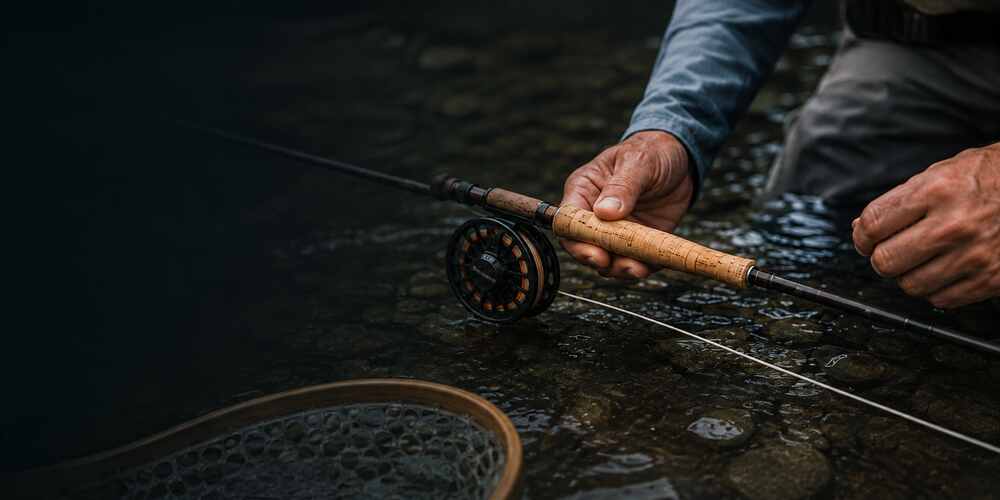
Trout in Texas sounds wrong until you are standing in cold water below Canyon Dam with your indicator sliding sideways.
Each winter, the Guadalupe becomes one of the most interesting fisheries in the state. Knowing trout were stocked is the easy part. Catching them means finding where they moved, reaching the right depth, and giving them a clean drift.
Who stocks trout in the Guadalupe?
Two organizations play major roles: the Texas Parks and Wildlife Department and Guadalupe River Trout Unlimited.
TPWD stocks rainbow trout in public waters across Texas each winter and focuses its Guadalupe efforts on the Canyon Tailrace below the dam. Dates and public-access arrangements change, so review the official TPWD trout stocking schedule before planning a trip.
GRTU supplements the state program with major stockings of its own. The chapter reports that it generally conducts two stockings and adds approximately 16,000 pounds of trout annually. Its Lease Access Program gives participating members access to private river properties.
A stocking does not make private land public. Use a designated public site, participating business, guide, property where you have permission, or the GRTU program.
A stocking point is only the beginning
Freshly stocked trout may gather near their entry point, but they do not remain there indefinitely. Current, flow changes, fishing pressure, food, and temperature encourage them to spread into nearby pools and runs.
Look for current seams, soft water behind boulders, drop-offs below riffles, deep troughs beside faster current, pool heads, tailouts, ledges, and depressions. A fish may sit in slower water while watching a faster seam deliver insects. The best cast puts the flies in that feeding lane.
The indicator rig we start with
Where current rules allow, our most consistent setup is a larger attractor followed by a small nymph. Start with a floating line, a 9-foot leader, a visible indicator, enough weight to reach the fish, a Pat’s Rubber Legs as the lead fly, and a smaller nymph on the point.
The Pat’s has the size and moving legs to get attention. A Pheasant Tail, Zebra Midge, Hare’s Ear, Perdigon, RS2, or small egg behind it often gets the actual eat. Twelve to 20 inches between the flies is a useful starting point. Adjust from there for depth and visibility.
Keep it manageable. A clean two-fly rig you can cast accurately beats a complicated rig that spends half the day tied around itself.
Depth is more important than the perfect fly
Anglers often change flies when the real problem is depth. If trout are feeding near the bottom and your nymphs drift several feet over them, switching from one tiny fly to another will not help.
As a starting point, place the indicator about one-and-a-half to two times the estimated water depth above the flies. Use enough weight to touch bottom occasionally without dragging constantly. Add or remove one split shot, or move the indicator several inches, before replacing the whole rig.
Watch the indicator closely. A trout may only make it hesitate, tilt, move sideways, or travel more slowly than nearby bubbles. When in doubt, use a short controlled lift or strip set.
The flies should travel at approximately the speed of the current. Cast upstream or upstream-and-across, mend without moving the indicator from its lane, and use nearby bubbles as a reference. A short controlled drift usually beats a long drift pulled by the fly line.
Leaders and tippet
A 9-foot leader ending in 4X is a dependable starting point. Move to 3X for larger attractors, higher flows, stained water, or stronger fish. Use 5X for small midges and pressured clear water, and reserve 6X for situations that truly require it.
Use the strongest tippet the fish will accept. Landing a trout efficiently is better than extending the fight on unnecessarily light material. Fluorocarbon is useful below the surface; nylon remains a good choice for dries and dry-droppers.
Ten flies for Guadalupe trout
- Pat’s Rubber Legs. Our preferred lead attractor in black, brown, olive, or coffee.
- Pheasant Tail. A dependable mayfly imitation and one of our first point-fly choices.
- Zebra Midge. Carry black, red, olive, and cream versions in several small sizes.
- Hare’s Ear. A rough, natural profile that suggests several aquatic insects.
- Perdigon. A slim, fast-sinking fly for deeper pockets and faster current.
- RS2. A sparse mayfly or midge emerger when trout reject bulkier flies.
- Egg pattern. A visible choice for recently stocked fish; reduce size in pressured water.
- Worm or mop fly. Productive after rain, in stained water, or when conventional patterns fail.
- Woolly Bugger. Strip, swing, or dead-drift black, olive, and rust versions.
- Rio Bandito. A versatile local point fly that can also attract other river species.
An indicator rig is our starting point, not the only option. Try a dry-dropper in shallow water or when fish feed higher. Swing or strip a Woolly Bugger when flows rise, the water gains color, or trout become active.
Why we recommend the Guadalupe 5w
Our primary Guadalupe trout rod is the Guadalupe 5w. Its 9-foot length provides reach for mending, managing an indicator, and steering fish away from fast water.
The medium-fast action supplies recovery for wind and weighted rigs without demanding an excessively fast tempo. It can also protect light tippet and cover dry flies, dry-droppers, and small streamers.
The Creek can be enjoyable in lower flows, tighter water, and with lighter flies, but the Guadalupe 5w is the more versatile choice for general tailwater fishing.
Access, regulations, and water temperature
Much of the river crosses private property. Seeing water from the road does not make it public. Before fishing, choose a public site, GRTU lease, participating campground or resort, guided float, or another place where you have permission.
Parts of the tailwater have special artificial-lure, length, and bag regulations. Review the current TPWD Guadalupe River regulations before every trip.
Water temperature changes as the river moves downstream. Check GRTU’s live flow and temperature page. GRTU advises care at 65°F or below, caution from 65°F to 68°F, and stopping trout fishing above 68°F.
Land fish quickly, keep them wet, use wet hands, and release them promptly. When the water gets too warm, chase bass, panfish, or Rio Grande cichlids instead.
“Sometimes the difference between fishing and catching is one split shot, six inches of depth, and a better drift.”GUADALUPE ROD CO
HANDCRAFTED IN TEXAS
Made to be fished.
Keep reading, explore rods assembled, wrapped, finished, and inspected by hand in New Braunfels, or tell us about the water you fish.